9 Months of Real Charging Costs – Autumn, Winter, and Spring Statistics
Welcome back! In the previous part of "EV Openly", I listed the numbers that made me sell my VW Arteon. Today, as promised, we will open completely open statistics. No speculation or theories from advertising leaflets. Let's look at pure facts and my personal expenses over 9 months.
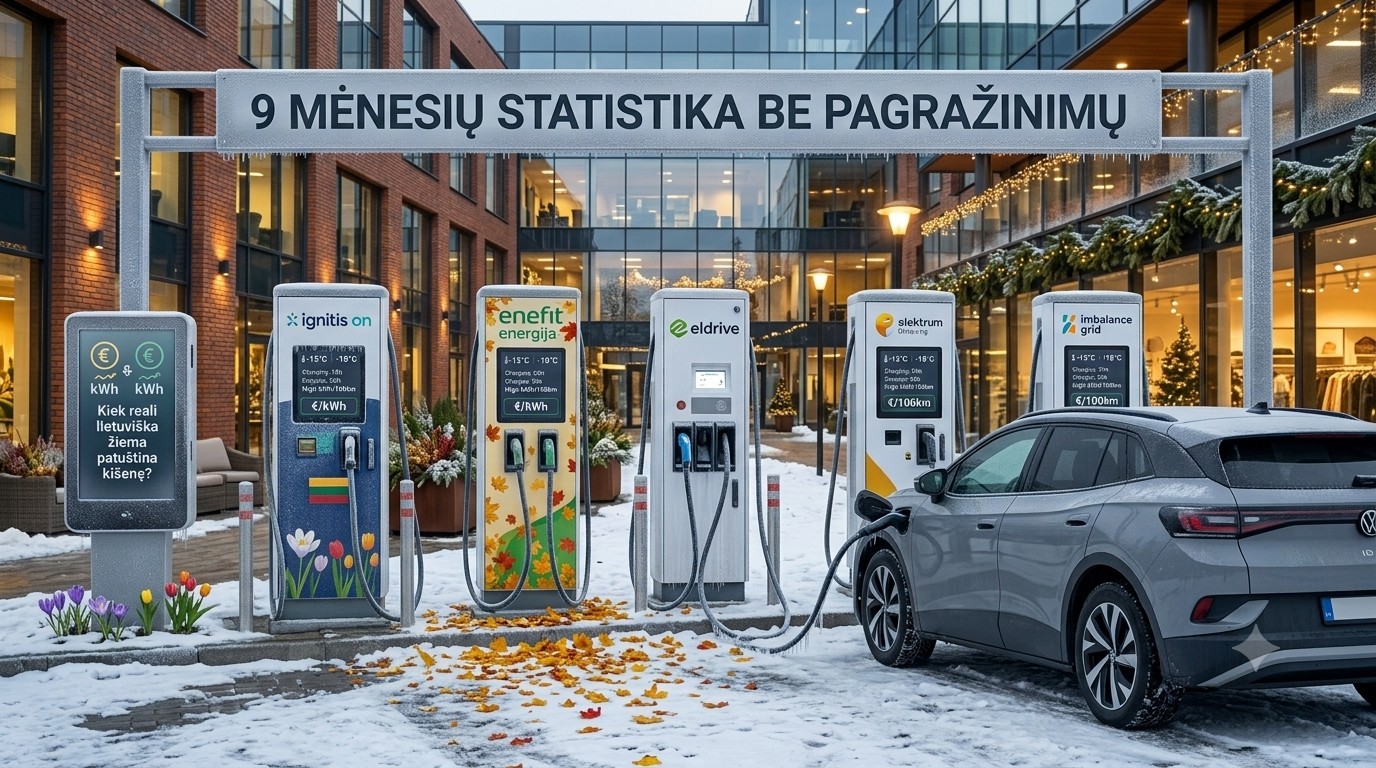
Welcome back!
In the previous part of "EV Openly", I listed the numbers that made me sell my VW Arteon. Today, as promised, we will open completely open statistics. No speculation or theories from advertising leaflets. Let's look at pure facts and my personal expenses over 9 months. I picked up the car on October 9, 2025 with a mileage of 67,222 km. Today the odometer shows 86,455 km. This means that we drove exactly 19,233 km together. This period can be divided into three seasons of 3 months each. Let's see what my VW ID.4 Pro Max's appetite was on the public charging network and what changed in June, when its own charging station appeared in the yard.
Three seasons – three different realities
Stage 1: Autumn (October – December 2025) When I started driving an electric car in autumn, the weather was not yet extremely cold, and the prices of public charging stations allowed me to enjoy good savings. • Total publicly charged: 1,507.38 kWh • Monthly average: 502.46 kWh • Average price of 1 kWh: €0.282 • Average monthly expenses: €141.69 Stage 2: Cold winter (January – March 2026) Here the real test of the electric car began. When serious frosts hit, the battery required much more energy for heating and comfort in the cabin. The numbers shot up. • Total public load: 1,969.60 kWh • Monthly average: 656.56 kWh (30% higher demand than in autumn!) • Average price per kWh: €0.318 (operators also raised tariffs in winter) • Average monthly costs: €208.79 Stage 3: Spring (April - June 2026) The weather warmed up, costs began to fall, but this stage brought surprises from the side of network operators. • Total charged: 1,245.81 kWh • Monthly average: 415.27 kWh • Average price of 1 kWh in public: €0.300 • Average costs per month: €127.58
The reality of charging networks: where it is worth charging, and where you will overpay
Since I know how to count money, I quickly realized that blindly turning to any station is financially unreasonable. Different operators offered completely different conditions during the same period.
Operator tariff comparison
| Operator | 2025 Autumn tariff (€/kWh) | 2025–2026 Winter tariff (€/kWh) | 2026 Spring tariff (€/kWh) | My verdict |
|---|---|---|---|---|
 Ignitis ON | 0.175 €/kWh | 0.207 €/kWh | — | In autumn and winter it was the undisputed leader. In spring, the price doubled – I simply stopped charging there. |
 Elektrum Drive | 0.290 €/kWh | 0.283 €/kWh | 0.343 €/kWh | It saved me a lot during the snowstorms, but they raised the prices in the spring. |
 Circle K | 0.326 €/kWh | 0.372 €/kWh | 0.372 €/kWh | I used it mostly because of the excellent network coverage, but in the winter and spring the prices really bit. |
 Fortum | 0.350 €/kWh | 0.396 €/kWh | 0.372 €/kWh | The most expensive point on the map. In the winter the price was almost 40 cents. I used it only in extreme cases. |
 VOOL | — | 0.290 €/kWh | 0.290 €/kWh | A stable, neat and smart alternative to charging on the highway. |
June: your own station at home
Everything you read above was an experience in a public charging network. However, in June I installed a smart VOOL charging station at home. This is where the real savings begin. Look at the contrast in June: • Public charging (1 time Ignitis ON): 40.70 kWh charged, €15.09 paid (tariff – €0.370/kWh). • Home charging via a VOOL station: 350.21 kWh charged, €25.22 paid (tariff – €0.072/kWh)! Simple math: If I had charged the same 350.21 kWh in June on the public Ignitis ON network, it would have cost me around €129.58. In just one summer month, the station at home saved me over €100! Since I have a solar power plant on my roof, I store energy after the winter in order to fix this 7.2 cent price during the heating season.
Final summary: My ID.4 vs. my former Arteon (calculated at TODAY'S prices)
Now let's move on to pure numbers and discard theoretical tables from the Internet. Let's compare my VW ID.4 with my former tenth car - a gasoline VW Arteon. However, to make the comparison 100% fair, I will not calculate old fuel prices. Let's take my real Arteon fuel consumption and apply current fuel prices to it (the average for 95 gasoline in Lithuania is now 1.685 €/l) to see how much the same distance would cost me today. According to personal statistics, my Arteon actually used 6.84 liters of gasoline per 100 km in the combined cycle (2,302.84 liters divided by 33,683 km). During these 9 months I drove 19,233 km with the ID.4. • Energy consumption (Public + Home): 4,722.79 kWh • Charging costs during 9 months: €1,450.37 • Real cost of 100 km with EV (including cold winter): €7.54 If I had driven this 19,233 km distance today with the Arteon: • Fuel at today's prices (6.84 l/100 km × €1.685/l × 192.33): ~€2,217 • Current service (oil and filter change ratio for this distance): ~€423 • Total Arteon maintenance cost for this distance: ~€2,640
How much exactly is left in my pocket?
In real money terms, switching to an electric car and calculating at today's prices, I saved about 1,190 euros in 9 months. I want to emphasize one essential point. I achieved this saving of almost 1,200 euros by charging almost exclusively on the public network and having survived a very cold winter! This completely destroys the popular myth on the Internet that "an electric car without your own house and a solar power plant will never pay for itself". Even when paying public network operators, tangible money remains in your wallet. In the next stage, we will see statistics, when the car is charged at home 90% of the time for the same 7 cents, which means just €1.90 per 100 kilometers traveled. In the next posts, I will share in more detail the costs and nuances of installing the VOOL station itself, and I will also openly talk about the first minor problems and software flaws that I encountered while driving my ID.4. If you like real numbers and open experience - subscribe to the page, click "Like" and see you in the next episode!
About the "EV Openly" project
This blog was born not for profit, but out of a desire to lift the veil of secrecy from the real operation of electric cars - without marketing filters and embellishments. All texts and figures here will always be open and free. If this information was valuable to you, saved you time searching for answers or helped you make a decision, you can symbolically contribute to the project and "buy me a kilowatt-hour" by choosing one of the support amounts below. This is absolutely non-binding, but the best motivation for me to continue sharing open statistics. Thank you for reading!
Want to be first to know when a new part goes live? ⚡☕
I update this blog roughly every two weeks. Leave your email and I’ll personally send you a short note as soon as I publish something new. No spam, ever — just real numbers and an honest experience!