Character, Software Glitches and Friends' Road Test (Kaunas–Nida)
Welcome back! As I promised in the previous part, today we are diving into pure practice. Let's talk about what it really means to have an electric car from a technical point of view, how much current repairs cost, how the car behaves when fully loaded with a company of adults and whether it is true that its "brain" can completely freeze in winter.
Welcome back!
Welcome back! As I promised in the previous part, today we are diving into pure practice. Let's talk about what it really means to have an electric car from a technical point of view, how much current repairs cost, how the car behaves when fully loaded with a company of adults and whether it is true that its "brain" can completely freeze in winter.
🔧 Unofficial service and official "calm head"
Let's start with chassis repairs. Last winter I encountered a very unpleasant squeak in the front. At first I suspected support bearings, but on foreign forums I quickly found the real reason - factory bushings that cannot withstand the weight of electric cars. This is a mass disease of this model. I decided to change them. I did not do it in the official "Autojuta" salon, because the prices there bite, but I chose the no less respectable "JUTA" car service. Do you think that repairing a used electric car costs a fortune? I'll surprise you: replacing both bushings with work and parts from a reliable manufacturer Lemförder didn't cost me more than €120. True, as soon as I bought the car, I still took it to an official VW dealership for a full technical service. Preventive maintenance cost over €300, but everything required by the regulations was done: • Inspection technical service and brake fluid replacement. • Replacement of dust and pollen filters. • Air conditioning system service and... carbon dioxide (CO₂) filling (this system is responsible for cooling and heating the battery). • ODIS electrical function check. Since technical services for EV cars are performed every 30,000 km or every 2 years, paying this amount to an official dealer is definitely worth it just for peace of mind. By the way, it is officially recommended to check the brake system every year. Since an electric car usually brakes with regeneration (using the engine to convert inertia back into electricity), physical brake discs and pads are used very rarely, so they can simply start to rust.
💻 A car with character: about software "glitches"
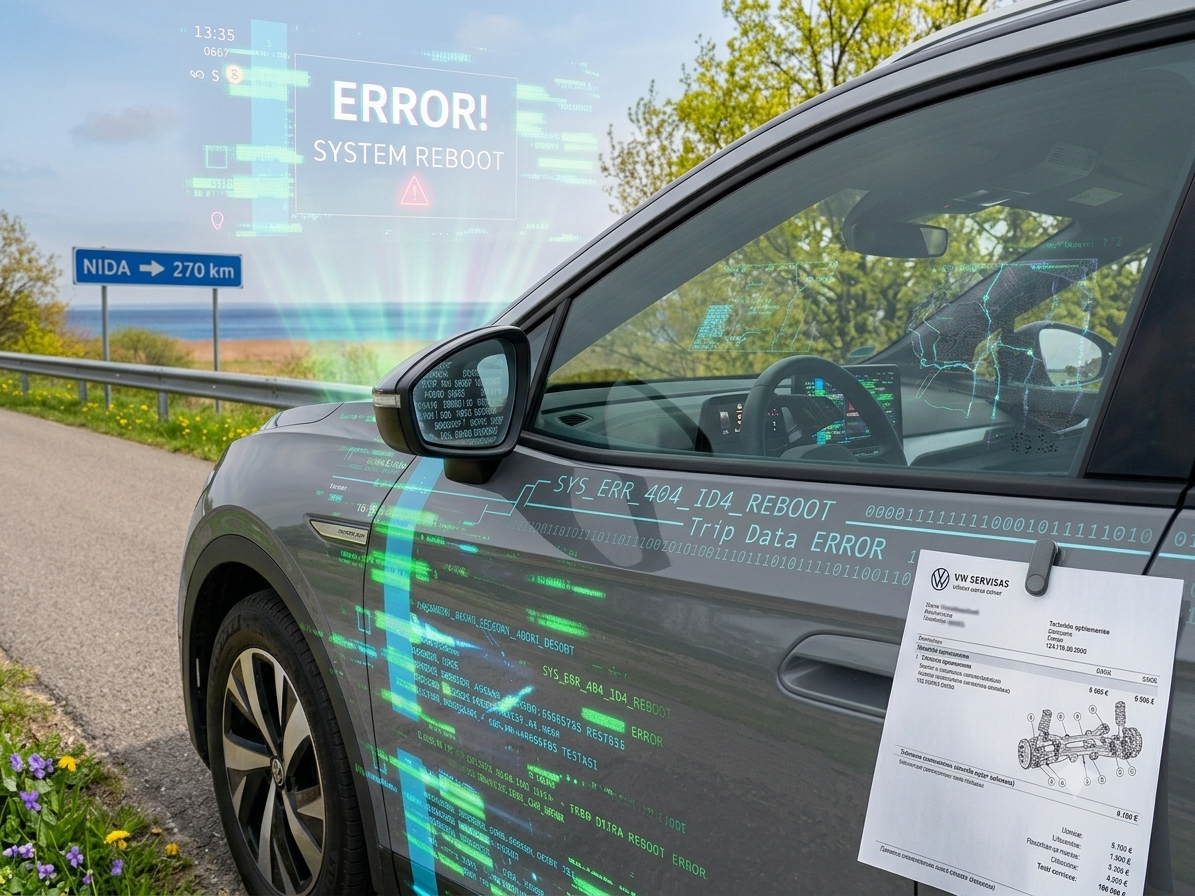
Many are afraid to switch to EVs because they think that everything is built on electronics - "the mind will slow down and you will be left standing in the fields". I'll be honest: I had moments of panic at the beginning, but the car simply has its own character. What does this character mean? Sometimes in the morning the car simply decides that today the adaptive cruise control (ACC) will not work. Sometimes it declares that it "does not see" obstacles in front. And recently there was a case when the ID.4 simply stopped showing the time, outside temperature, or average consumption on the screen. Does it look threatening? In reality - not at all. Some of these warnings disappear just while driving, and the rest clear up when you arrive at the place, lock the car and leave it alone for an hour. The system simply reboots (restarts). None of the whims prevented me from achieving my goal. These are very rare cases that do not require panicking. 💡 Important advice for buyers: be sure to ask the seller what software version is installed. Currently, the latest stable version is 3.8.11. ID.4 uses OTA (Over-the-Air) updates via satellite, but they take a long time to download and install. If the car already has the latest version, you will save a lot of precious time.
🪫 Battery hygiene and driving modes (B vs D)
To make the battery last longer, use the golden rule for daily driving: charge it between 20% and 80%. Charge it to 100% only before long trips. Of course, nothing bad will happen if you sometimes discharge it to 3% or 10%, but you should not abuse it. In the city, I always drive in B (regeneration) mode – when you release the accelerator, the car brakes itself and effectively collects energy. On the highway (driving at 90 km/h and faster), I choose D (Drive) mode. In this mode, the ID.4 has an amazing "gliding" effect – when you release the pedal, the car rolls incredibly long and easily, which significantly reduces costs on the highway.
🏖️ Big test: Kaunas – Nida (3 vs 5 adults)
During these 9 months, I had two serious trips to Nida from the Kaunas region with groups of friends. They perfectly showed how the car's appetite and comfort are changed by weight, weather conditions and a full cabin of adults. • First drive (end of March): We traveled with three of us. The weather was disgusting – about 8 degrees Celsius, strong headwind and rain almost the entire way. When charged to 100%, the car predicted a distance of 395 km. We drove at a speed of 110 km/h. In Kryžkalnis, at the Inbalance Grid station located at the Orlen gas station, we stopped with 47% battery remaining. In 23 minutes we charged to 80% and moved on. We reached Klaipėda with 43% remaining. Although we would have reached Nida without any problems, we charged to 100% while having lunch in Klaipėda just so that we wouldn't have to pay the more expensive resort rates in Nida. • Second ride (end of May): This time there were five of us – a car full of adults. The pace was the same – 110 km/h, the weather was better (about 14 degrees heat), the roof is dry. The trunk was crammed to the very top.
📦 What actually fits in the ID.4 trunk? We managed to fit: 2 medium suitcases, 3 normal backpacks, 5 pairs of roller skates, 4 down jackets, a few small bags and 4 extra pairs of shoes. Everything fit very tightly. Of course, there is nothing to compare with the Arteon trunk, but we managed successfully. What about the space in the cabin? Very interesting details came out. I am 1.91 m tall, a fairly large man. The driver's seat is pushed back decently, but an adult sitting behind me felt completely comfortable the whole way - knee space on the MEB platform is really at will due to the flat floor. True, there are no miracles: the fifth passenger, sitting in the very middle of the back seat, admitted that this place is not particularly comfortable for a long trip. What is most interesting about the costs – in better weather, although the car was maximally heavy this time, we stopped at the same Kryžkalnis stop with 48% remaining (even 1% better than when driving in three in the rain!). We charged up to 80% in 22 minutes, and reached Klaipėda with 52% remaining. This proves once again that for an electric car, weather conditions and wind have a greater influence than the additional weight in the cabin.
❄️ Short tips for surviving winter
• 17.5 °C trick: If you maintain the temperature in the cabin at 17.5 °C in winter (the air inside will still be warm), you will drive noticeably further than if you set the standard 21 °C. • "Heat pump" (heat pump): When buying an ID.4, be sure to look for a model with this function. You can warm up the battery and cabin before the trip via the phone app while still at home (especially when it is -20 °C outside). A warmed-up battery consumes drastically less energy when driving. • No drifting: My ID.4 is rear-wheel-drive only. It would seem that it would be fun to corner in the winter, but... no. The stability and safety systems are programmed so strictly that the car does not allow you to lose control for a moment. Everything is as safe as possible. • Weak point - 12V battery: Be sure to ask the seller if the simple, small 12V battery (which powers the car's electronics) has been changed. This is the weak point of these models during the cold. If it has not been changed since the factory - change it as a precaution. It costs about €90-110, but you will avoid a situation where the car simply "does not wake up". In the next post, we will open another highly anticipated topic - charging stations at home. Which ones to choose? How much does installation cost? Why did I choose VOOL? We will also talk in more detail about the real charging time at public fast charging stations. See you in the next episode!
About the "EV Openly" project
This blog was born not for profit, but out of a desire to lift the veil of secrecy from the real operation of electric cars - without marketing filters and embellishments. All texts and figures here will always be open and free. If this information was valuable to you, saved you time searching for answers or helped you make a decision, you can symbolically contribute to the project and "buy me a kilowatt-hour" by choosing one of the support amounts below. This is absolutely non-binding, but the best motivation for me to continue sharing open statistics. Thank you for reading!
Want to be first to know when a new part goes live? ⚡☕
I update this blog roughly every two weeks. Leave your email and I’ll personally send you a short note as soon as I publish something new. No spam, ever — just real numbers and an honest experience!